
Brands lose a significant amount of revenue by only thinking of the immediate sale. Sure you may have emails generating 30% of total sales, you may even have a 60%+ customer repurchase rate, but if you only think of a rewards program as a sales channel and NOT a growth driver, you’re missing the point.
E-commerce businesses typically utilize rewards programs to encourage customer loyalty and repeat purchases. These programs offer incentives such as discounts, cash-back, and exclusive perks to customers who make frequent purchases or refer friends to the business.
So if customers are being incentivized by discounts, cash-back and exclusive perks, why do over 70% of customers simply ignore them? Or if they’re not ignoring a brand’s invitation to join the rewards program, why else are they opting out of potential rewards or savings they could be applying to their next purchase?
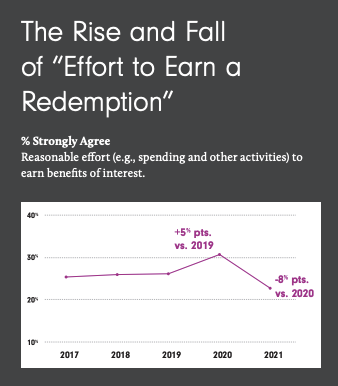
From The Loyalty Report 2021 Executive Summary, Bond Brand Loyalty
I have been thinking about this a lot lately, especially since working with many brands over the years who have had lackluster results in growing their rewards programs. It seemed to be an enigma to me as a marketing manager – why were rewards and loyalty points being ignored? Why was the 15-20% off discount offer not being taken? We would go through extraordinary lengths to figure out why our rewards were not being redeemed. Was it the rewards landing page? Were the terms not clear enough? Did we have a major trust issue? Did our customers just not find the offer appealing? Was the point system confusing? I built a google analytics tracking structure to track and measure all of the touch points for our rewards program to see where the disconnect was occurring.
Turns out it was a delicate mixture of all those things but the biggest issue was that we were simply following industry practices and not thinking outside the box. Basically, our rewards were not relevant to our customer – they were not moved by discounts or special sales or exclusive perks. The next step was to figure out how to make the rewards TRULY relevant to our consumer.
If you’ve been reading this blog long enough, you’re starting to see a pattern with the tips and advice I give – every aspect of successful marketing is connecting to the customer, the human being. This also includes building a reward program that not only retains customers but one that is a growth driver in and of its self. Essentially, good reward programs are tailored to their customers wants and needs.
Let’s remove the discounts, cash-back and exclusive perks as the core benefits to your rewards program. What drives your customer? What’s their main objection? What common drawbacks do they typically face? And once you’ve figured that all out: do the solutions you come up with (essentially what would become your new rewards program’s perks) make sense to your business’ operations and bottom line?
Baby, the days of sitting and collecting points to redeem towards a purchase are over and only a few brands have mastered this. Today’s consumer, according to this study by Bond Brand Loyalty, is generally expecting to redeem their rewards quickly. But what else, aside from increasing reward relevancy for our customers, can brands do to increase reward program participation?
Offer enhanced tiers based on customer length of time (CLV) or repeat purchases (RR)
So hear me out – I understand the allure of a point-based rewards program. However, why not spice up your reward program with three to four tiers based on customer time length, where you reward your customers based on how long they’ve been engaged with your brand (this may work best for low-frequency products), OR based on the number of repeat purchases. Another variation of a repeat purchase-based rewards program is total customer spend. These redemption goals are easier to understand and attain, especially if your products are priced right AND your product is highly consumable, a.k.a a high-frequency product. Your enhanced tiers must be rewards that are relevant to the customer. It should be a perk that is easily understood and clearly defined. For example, a cosmetics marketplace might offer a 1st level member a birthday gift vs. no gift for 2nd or 3rd-level members.
Time rewards to customer behavior
Timing is what’ll set you apart from other brands and make participation rates rise. What if you were able to fashion your redemption goals close to when your customer’s typically ready to repurchase? Or for lower frequency brands, wouldn’t linking your programs redemption goals to when a current customer is considering an accompanying product or upgrade to their initial purchase make upsells and cross-sell opportunities all the more successful? Think about how you can incorporate rewards that drop at the right time. This, in my opinion, makes reward programs beneficial to customers and likely to raise participation by default.
Moments of randomness (variable rewards + good timing = delighted customer)
Now this is something to consider carefully because this ties into how it fits with your brand’s operations or bottom line. But if your business allows for it, why not inject random moments for the most loyal of your customers? Aside from giving them access to secret sales, early-bird promos or deeper discounts than the rest of your customer base, why not offer unique rewards with a more personal touch?
This could be anything from a special invitation to test a soon-to-launch product or a handwritten letter from the CEO thanking them for being loyal and a free gift. For something more across the board, this could be an invite to a secret FB group or a weekly giveaway of a free product drawing from customers who purchased that week. Or it could be early access to a mystery box like the size-inclusive fashion brand, Universal Standard did with their customers. How cute!
The sky’s the limit here – just think of what would truly elate your customer. These are the kinds of moments that get customers posting about your brand on social media or sharing your brand with their friends and family. As a brand, you should re-think the relationship between your brand and your customer. I’ll leave you with this thought: Maybe loyalty is really about how your brand can be loyal to your customer. Position your brand as people-focused first and see how your brand commands a higher share of your customer’s overall wallet.


